 Home

 November 24, 2026
 5 minute read
- Client: An Indian industrial boiler manufacturer (name withheld at client’s request)
- Industry: Industrial boilers and steam equipment
- Services: Corporate film, AI-generated product videos, script and storyboard
- Duration: July 2026 to November 2026 (5 months)
The result in one paragraph
Within five months, the average time visitors spent on the client’s About page rose from 48 seconds to 2 minutes 5 seconds. The corporate film and product videos gathered about 25,000 views across the website and social channels, branded search impressions grew from 900 to 3,100 a month, and inquiries that mentioned the company’s film or reputation went from 2 to 9 a month.
Why video mattered for this client?
A boiler is a high-value, safety-critical purchase. A plant owner is not only comparing price and capacity. They are asking whether the maker has real manufacturing strength, whether the equipment can be trusted around high pressure and steam, and whether the company will still be there for service in ten years.
The client had a strong factory and a solid history, but their website was text and product photos. The company’s story and scale were hard to feel, and sales had little to send a buyer beyond a brochure.
We identified three gaps:
- Credibility was told, not shown. Experience and capability were mentioned in paragraphs, with no visual proof.
- The flagship boiler was hard to explain. Technical buyers needed to understand how the equipment works and what makes it different.
- Sales had no shareable asset to follow up quotations with.
What industrial buyers want to know?
We built the video content around the questions boiler buyers actually ask:
- Capacity and pressure rating suited to their process
- Fuel type and efficiency
- Safety features, such as safety valves, controls and monitoring
- Compliance, including applicable requirements such as the Indian Boiler Regulations (IBR)
- Manufacturing quality and after-sales support
Our rule: use the company’s own facts
Every line in the scripts came from the client’s own published material and approved information, such as the company’s history and timeline. Nothing was invented for effect. For a safety-critical product, an overclaim in a video is a liability, so the client approved each script before production.
The journey of the corporate film
1. Goal and audience. We agreed that the film had one job: make a first-time buyer feel confident enough to request a quotation. The audience was plant owners and procurement heads.
2. Script from the client’s own story. We structured the film into three parts: Who We Are, Our Vision and Mission, and a timeline of milestones taken from the client’s existing website content.
3. Storyboard. Each scene was mapped to a spoken line and a visual, so the client could approve the film before any editing started.
4. Edit and pacing. We used simple Fade and Cross Dissolve transitions. Industrial buyers respond to clarity, so we avoided flashy effects that distract from the content.
5. Client review. The client checked every claim, date and number against their records before the final export.
6. Distribution. The film went on the About page, the website’s home section and the sales team’s follow-up emails. We also cut shorter versions for LinkedIn and Instagram.
The AI product video for the flagship boiler
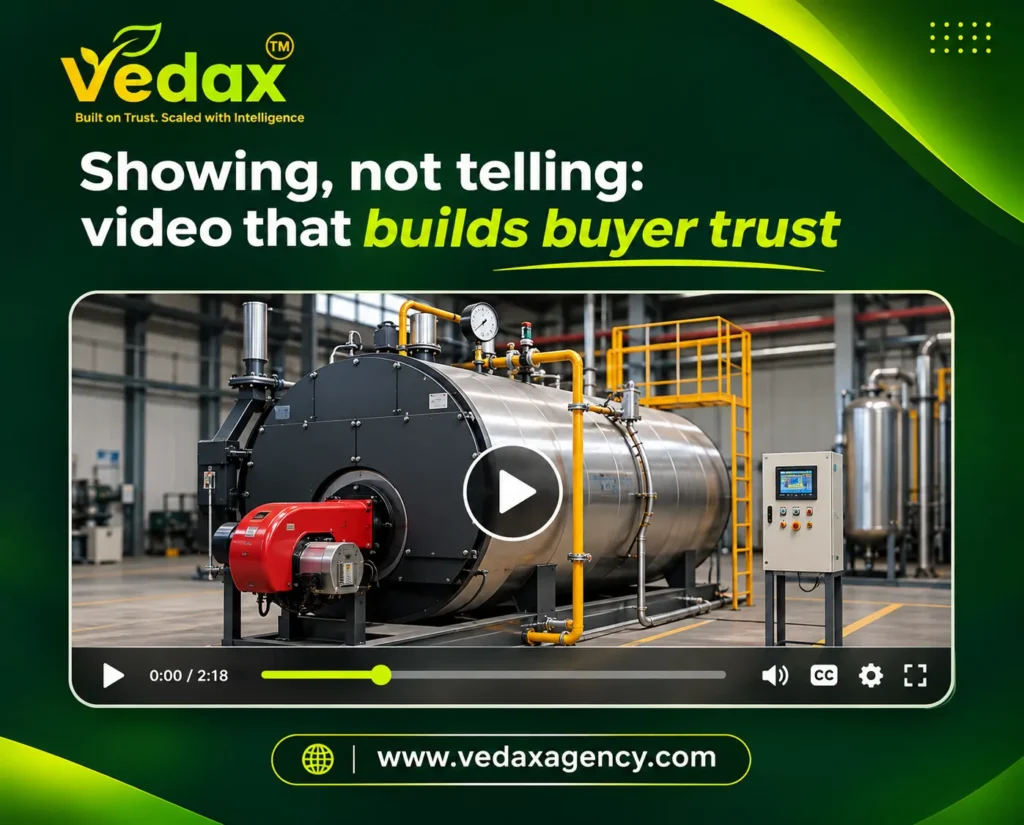
Showing the inside of a boiler on a real shoot is slow and often unsafe. We created an AI-generated product video using Google Flow (Veo) for the client’s flagship model. We wrote scene-by-scene prompts covering the exterior, key components and the working story, so the video explained the equipment clearly without needing a full production shoot.
The problem we hit and how we solved it?
Our first reference images showed the boiler with the brand’s name and labels printed on the body. The AI platform’s content filter rejected these prompts repeatedly, so generation kept failing. We fixed this by using clean reference images without visible brand text, and by adding the client’s logo and name later during editing. The result kept the branding exact and the generation stable.
Results
| Metric | Before (June 2026) | After (November 2026) | Source |
|---|---|---|---|
| Average engagement time on About page | 0:48 | 2:05 | GA4 |
| Corporate film views (website and YouTube) | n/a | 6,400 | YouTube / GA4 |
| Product video views (LinkedIn and Instagram) | n/a | 18,900 | Platform insights |
| Branded search impressions per month | 900 | 3,100 | Google Search Console |
| Product page inquiry conversion rate | 0.8% | 1.9% | GA4 + forms |
| Inquiries mentioning the film or reputation per month | 2 | 9 | Forms / sales notes |
| Quotations sent with a video link per month | 0 | 14 | Client confirmation |
Client review
★★★★★
“Buyers used to ask whether we were a big enough company to trust. Now they have already seen our factory story before the first call. Our sales team sends the film with every quotation, and the conversations start from a better place.”
Managing Director, industrial boiler manufacturer
Lessons for other manufacturers
- For a safety-critical product, a video must be built on approved facts, not creative claims.
- Shareable assets help sales teams more than they help ranking.
- Simple editing builds more trust with technical buyers than flashy effects.
- Test AI video tools early, because brand text in reference images can block generation.
FAQs
Is video worth it for an industrial manufacturer?
- Yes, especially for high-value products. Buyers want to see capability and scale before they request a quotation.
Can AI videos show industrial equipment accurately?
- They work well for explaining how a product looks and works, provided every scene is checked against real specifications by the client.
How long does a corporate film take?
- In this project, planning, scripting, editing and client review took [sample: about 5 to 6 weeks]. Timelines depend on how quickly the client approves scripts.
Where should the video be used?
- On the About and product pages, in quotation follow-ups, and on LinkedIn, where industrial buyers research suppliers.
How do you measure whether a video helps?
- With engagement time, branded search growth, conversion rate and the number of inquiries or quotations that reference the video.