 Home
Home

 July 23, 2026
 11 minute read
 If you have ever scrolled through Instagram and stopped mid-scroll on a product ad that felt made just for you, that’s social media advertising doing its job. It is one of the fastest, most measurable ways for a business to reach the right audience—and in 2026, with AI-driven targeting and generative ad tools, it’s more precise than ever.
Businesses across India and globally are shifting more of their marketing budget toward paid social every year, simply because it lets you reach a very specific person, at a very specific moment, with a message built for them. That level of precision is something traditional advertising — TV, print, or even generic Google Display ads — struggles to match.
This guide breaks down what social media advertising is, how it works, the platforms and ad types you can choose from, and the practical tips that actually move the needle on conversions — not just likes.
What Is Social Media Advertising?
Social media advertising is the practice of paying to place content — images, videos, carousels, or stories — in front of a targeted audience on platforms like Facebook, Instagram, LinkedIn, TikTok, Pinterest, and X. Unlike organic posts, which only reach people who already follow you, paid social ads let you reach new, relevant audiences based on interests, behaviour, location, and demographics.
Social advertisement, in simple terms, is any sponsored content a platform shows because a brand paid for that placement, rather than because a user chose to follow the account. For a broader look at how digital advertising has evolved alongside social platforms, resources like Grokipedia offer useful background context on the space.
Organic vs Paid Social Media
| Aspect | Organic Social Media | Paid Social Media (Advertising) |
|---|---|---|
| Reach | Limited to followers & algorithm | Reach beyond followers, targeted |
| Speed of results | Slow, builds over time | Fast, often visible within days |
| Cost | Free (time investment) | Requires ad budget |
| Targeting | Broad, based on who follows you | Precise — age, interest, location, behaviour |
| Best for | Brand voice, community building | Lead generation, sales, launches |
Most growing businesses use both — organic content builds trust, while advertising accelerates reach and conversions. A common approach is to let organic posts test which messaging resonates, then put ad spend behind the content that’s already proven to perform.
How Does Social Media Advertising Work?
Running social media ads involves five core steps:
- Audience targeting – Define who should see your ad based on demographics, interests, location, or even people who’ve already visited your website (retargeting).
- Ad creation – Design the actual creative: an image, video, carousel, or story that fits the platform’s format.
- Budgeting – Set a daily or lifetime budget. Most platforms let you start small and scale once you see results.
- Bidding – The platform runs an auction where advertisers “bid” for ad placement, factoring in budget and relevance.
- Performance tracking – Monitor click-through rate, cost per click, and conversions to see what’s working.
The advantage of this system is that everything is measurable. Unlike a billboard or a newspaper ad, you know exactly how many people saw your ad, clicked it, and converted — in real time. This real-time feedback loop is what makes social media advertising fundamentally different from older forms of marketing: instead of waiting weeks for results, you can adjust a campaign within hours of it going live.
Most platforms also use machine-learning algorithms to automatically find the users most likely to convert once you give them enough data — which is why campaigns typically get more efficient the longer they run, provided you don’t restart them from scratch too often.
What Are the Benefits of Social Media Advertising?
For a business just starting to invest in paid promotion, the benefits of social media advertising are hard to ignore:
- Targeted reach – Show your ad only to people likely to be interested, instead of a broad, uninterested audience.
- Brand awareness – Even users who don’t click still see your brand, building familiarity over time.
- Website traffic – Drive qualified visitors straight to your landing pages or product pages.
- Lead generation – Native lead forms on platforms like Facebook and LinkedIn capture contact details without users leaving the app.
- Measurable results – Every rupee spent is trackable, so you can double down on what works and cut what doesn’t.
These benefits of social media ads make paid social one of the most cost-efficient channels available to small and mid-sized businesses, especially compared to traditional advertising.
What Are the Different Types of Social Media Ads?
Not every social ad format works for every goal. Here’s a quick breakdown:
- Image ads – Simple, single-image ads, great for quick brand messages or offers.
- Video ads – Short, engaging videos that work well for storytelling or product demos.
- Carousel ads – Multiple images or videos in one ad, ideal for showcasing a product range or a step-by-step process.
- Story ads – Full-screen, vertical ads that appear between users’ Stories — high engagement, short lifespan.
- Lead ads – Built-in forms that let users submit their details without leaving the platform.
- Shopping ads – Product-tagged posts that let users buy directly from the ad.
Choosing the right format depends on your goal: awareness, traffic, leads, or direct sales.
Which Platforms Are Used for Social Media Advertising?
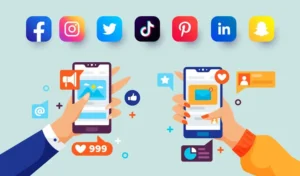
Different social media advertising platforms serve different audiences and objectives:
- Facebook – Broadest reach, strong for local businesses and retargeting.
- Instagram – Visual-first, strong for lifestyle, fashion, and D2C brands.
- LinkedIn – Best for B2B lead generation and professional services.
- TikTok – Younger audience, high engagement with short-form video.
- Pinterest – Strong for e-commerce, home decor, and discovery-stage shoppers.
- X (formerly Twitter) – Good for real-time engagement and trending conversations.
Picking the right social media ad platform matters more than trying to be everywhere at once. A B2B software company will get far more value from LinkedIn than from Pinterest, for instance.
A simple way to decide where to start is to look at where your existing customers already spend time online, rather than guessing. If you sell a visual, lifestyle product, Instagram and Pinterest usually outperform LinkedIn. If you sell a service to other businesses, the reverse is almost always true. Many brands eventually run campaigns across two or three platforms once they know which audience segments respond best, but it’s rarely worth starting on all six at once — spreading a small budget too thin makes it harder to gather enough data to optimise any single platform properly.
What Tools and Strategies Are Used for Social Media Advertising?
The right social media advertising tools and strategy separate campaigns that convert from ones that just spend budget:
- Audience research – Understand who you’re targeting before you write a single ad.
- Retargeting – Show ads to people who’ve already visited your site or engaged with your content — they convert at a much higher rate than cold audiences.
- A/B testing – Run two versions of an ad to see which creative, headline, or audience performs better.
- Conversion tracking – Install tracking pixels so you know exactly which ads lead to sales or sign-ups.
- Ad optimisation – Regularly review performance and reallocate budget toward top-performing ads.
Using paid social media advertising without a strategy is one of the most common reasons campaigns underperform — the tools matter, but the strategy behind them matters more.
7 Social Media Advertising Tips to Increase Conversions
Running ads is easy. Getting them to convert consistently is where most businesses struggle. These practical tips can make a real difference:
- Lead with the problem, not the product. Ads that open with a relatable pain point outperform ads that open with a product shot — people stop scrolling for themselves, not for your brand.
- Keep the first three seconds strong. For video and story ads, if you haven’t hooked the viewer in the first three seconds, the rest of the ad rarely gets watched.
- Match the landing page to the ad. If your ad promises a discount, the landing page should show that discount immediately — mismatched messaging is one of the biggest silent killers of conversion rate.
- Use retargeting before cold traffic. Warm audiences who already know your brand convert far more easily than a completely new audience, so give retargeting campaigns priority budget.
- Test one variable at a time. Change only the headline, or only the image, in an A/B test — changing everything at once makes it impossible to know what actually worked.
- Add social proof. Reviews, ratings, or a simple “trusted by X customers” line inside the ad creative builds credibility before someone even clicks.
- Refresh creatives every 2–3 weeks. Ad fatigue sets in fast on social platforms; rotating in new visuals keeps cost per click from creeping up.
Small, consistent improvements across these areas compound — a 10% lift in click-through rate combined with a 10% lift in landing page conversion rate can nearly double your overall results.
Common Social Media Advertising Mistakes to Avoid
Even experienced marketers fall into a few recurring traps:
- Targeting too broad an audience — casting a wide net feels safer but usually wastes budget on people who were never going to convert.
- Ignoring mobile experience — the vast majority of social media traffic is mobile, so a slow-loading or desktop-only landing page will quietly kill conversions.
- Not setting a clear objective before launching — awareness, traffic, and conversion campaigns are optimised differently by the platform’s algorithm, so picking the wrong objective works against you from day one.
- Turning campaigns off too soon — most ad platforms need a short learning period before performance stabilises; judging results in the first 24–48 hours is usually premature.
What Are the Advantages and Disadvantages of Social Media Advertising?
Like any marketing channel, understanding the advantages and disadvantages of social media advertising helps set realistic expectations.
Advantages:
- Precise targeting and fast results
- Full control over budget
- Detailed, real-time performance data
- Works for almost any industry or business size
Challenges:
- Advertising costs can rise in competitive industries
- Competition for attention is high — users see hundreds of ads a day
- Creative fatigue — the same ad shown too often loses effectiveness and needs regular refreshing
The key is treating social media advertising as an ongoing process of testing and refining, not a one-time setup.
Why Choose a Professional Social Media Advertising Agency?
Running ads yourself is possible, but a lot of budget gets wasted on trial and error without the right experience. A specialised agency brings:
- Campaign planning built around your specific business goals
- Audience targeting informed by data, not guesswork
- Ad creative strategy that’s tested to convert, not just look good
- Campaign optimisation that adjusts spend toward what’s actually working
- Performance reporting so you always know your return on ad spend
At Vedax Agency, we manage social media advertising campaigns alongside SEO and PPC marketing, so your paid social strategy works together with your organic search presence rather than in isolation. We’re also increasingly seeing brand visibility shift toward AI-driven answer engines — something we cover in more depth in our guide on optimising for Google AI Overview and AI search.
Independent industry analyses, including research from aimojo.io, have also pointed to social advertising as one of the fastest-growing digital ad segments globally, reinforcing why more brands are shifting budget here every year.
FAQs
Q.What is social media advertising?
- It’s paid promotion on platforms like Facebook, Instagram, and LinkedIn that puts your content in front of a targeted audience beyond your existing followers.
Q.What are the benefits of social media advertising?
- Targeted reach, measurable results, faster brand awareness, and cost-efficient lead generation compared to traditional advertising.
Q.How does social media advertising work?
- You define an audience, create an ad, set a budget, enter the platform’s bidding auction, and track performance to optimise over time.
Q.What are the different types of social media ads?
- Image, video, carousel, story, lead, and shopping ads — each suited to a different marketing goal.
Q.Which platforms are used for social media advertising?
- Facebook, Instagram, LinkedIn, TikTok, Pinterest, and X are the most widely used platforms, each suited to different audiences.
Q.How much does social media advertising cost?
- Costs vary by industry and competition, but most platforms let you start with a small daily budget and scale based on results.
Q.Is social media advertising effective for small businesses?
- Yes — precise targeting means even small budgets can reach a highly relevant audience, making it accessible for businesses of any size.